-
AVFTCN 042 – How Many Satellites Are Planned for LEO? (Also… Australia travel)
How many satellites are currently planned for low Earth orbit (LEO)? 10,000? 100,000? 500,000? 1,000,000? 10,000,000? The answer is higher than you might expect in terms of filings with the International Telecommunication Union (ITU)… the real question is: how many will actually launch into orbit?
I gave a presentation about all of this at the SPACE Research Group session at the recent IETF 126 meeting in Vienna. I’ll share some links and more info below.
[Side note: I have some work travel in Australia next week: Canberra (August 17-19) and Brisbane (August 20-22). My schedule is tight but if you are in those areas, please feel free to reach out (see contact info at end) and say hello. I always enjoy connecting with readers and maybe a coffee/tea/drink might be able to be squeezed in somewhere!]
Millions of LEO Satellites
The SPACE Research Group is part of the Internet Research Task Force or “IRTF” that meets alongside the Internet Engineering Task Force, or IETF. The IETF produces the open standards for the protocols that make the Internet work (things like HTTP, DNS, SMTP, TLS, etc.) and the IRTF focuses on research into Internet-related topics that are farther out on the horizon.
“SPACE” of course in the IETF/IRTF way is actually an acronym for “Systems and Protocol Aspects for Circumstellar Environments”… but you can think of it as “the place for research about outer space” within the IRTF.
The SPACE RG session at the 126th meeting of the IETF in Vienna, Austria, included a range of research papers and topics for discussion.
My presentation was up first – and was titled “Beyond Starlink: Understanding the Coming Waves of LEO Satellite Deployments“. My point was to ensure researchers and others were aware of the absolutely INSANE number of filings with the ITU that have been going on over the last couple of years.
My slides are available online. And you can watch my presentation (it’s about 15 minutes):
One note – I had an error in my slides. On slide 8 for AST SpaceMobile, I put “~100” for the number of planned satellites. The actual number filed was 248. I’m not quite sure how I made that error… but it’s there.
One key point to understand – when a provider like SpaceX wants to launch more satellites, they go through a process like this (it varies by country – read more):
- The provider files a request with the regulator in the country in which they are based noting the frequencies they want to use for uplink and downlink connectivity. In the US, this is the Federal Communications Commission (FCC) as this relates to spectrum.
- The national regulator then approves (or not) the filing, and then, if approved, files that info with the ITU to reserve the spectrum usage and communicate the orbit info (heights, inclination).
- The provider then has seven years to launch their first satellite, and after that launch, they then must get 10% launched within 2 years, 50% in 5 years, and 100% by 7 years. If they fail to do so, they theoretically lose their claim on that spectrum reservation. (Although their national regulator can grant them an extension, as the FCC recently did for Amazon.)
So the constellations that I was talking about are in various stages of filing and deployment. Some like Starlink’s first constellation are obviously already in space. Their subsequent constellations have been filed with the FCC and ITU, and some have launched while others are just ideas at this point.
And Even MORE …
And of course my slides were outdated even as I posted them with regard to the number of satellites launched. I think SpaceX launched another 60 or 100 satellites between the time I submitted the slides and when I presented them! 🤯
But of course they MUST launch more satellites because the LEO satellites only have a lifespan of about 5 years! So they pretty much always have to “always be launching!”
Additionally, there were at least two other filings since the time of my talk:
- Amazon filed to launch 5,105 satellites for “direct-to-device” connectivity – this will be in addition to all the other satellites they have filed for within their existing “Leo” constellation. This looks to be a result of their acquisition of Globalstar, an existing LEO provider, who already has some available spectrum.
- The EU is expanding IRIS2 from 282 to 348 satellites, adding 66 more into LEO. Note that none of the IRIS2 satellites have launched yet and the EU is planning for the constellation to start operating in 2029.
There were undoubtedly some other filings since my talk, too, that I just haven’t seen yet.
A key site I use to keep track of the madness is Jonathan McDowell’s Planet 4589 site, specifically:
- List of mega-constellations (>1000)
- List of large constellations ( 50 – 1000)
He’s been doing amazing work for years to track what is going on!
And it was HIS numbers that led me to the number of planned satellites at the end of my presentation:
- 2,345,078 🤯🤯🤯
But Will All These LEO Constellations Happen?
That’s the big question! The reality is that there is NOT ENOUGH LAUNCH CAPACITY right now to even remotely get all these satellites into orbit!
SpaceX is the only company that has been launching consistently and at a fast cadence. There’s a launch company in China that is getting more frequent. Rocket Lab is another company trying to do more (and they just bought the Iridium LEO constellation!). The longstanding launch companies of Arianespace and United Launch Alliance (ULA – a combination of Lockheed and Boeing) are still stuck in a transition to their new rockets. The startup Blue Origin is working to get back into space after a recent explosion.
There’s a whole other article that I’ll write about this at some point…
My own answer is… NO, I don’t think even half of these constellations will actually make it into LEO!
But we’ll see… and even if only half, or even a quarter, get into space, it will be MORE satellites than we have EVER had!
Stay tuned!
The Passing of Om Malik
In my last AVFTCN 041 back on June 6, one of the “3 weekend longreads about the future of the Internet” was from Om Malik with his brilliant post about “Say Hello to the Internet of AI“.
I didn’t know it then – few people did – but Om was writing that post and many other posts from a hospital bed while he was dealing with some issues related to his heart. He passed away on June 24, 2026. 😢 I wrote a reflection on why he mattered to me – and what he did for all of us:
Bringing Back The Podcast! (And looking for guests..)
I have been so missing working with audio! I just love the medium and I enjoy talking with people and bringing stories in audio form. After 420 episodes, my “The Dan York Report” has been on an extended hiatus – and I want to change that!
I have a whole huge list of ideas… and I am working on carving out the time to make that happen. I also have some wonderful new
toystools for interviews such as these amazing Hollyland Lark A1 bluetooth mics! I’m looking forward to sitting down with some of the amazing people I meet and bringing you their stories.If you would be interested to be interviewed, send me a note about why we should talk! Drop an email back to me (or ping me on Mastodon or LinkedIn).
A “Crow’s Nest” Monthly Video Call?
I’ve still been giving a LOT of thought about building communities and connecting with others of similar interests. I’m thinking about the idea of doing a monthly video call (probably using Zoom) for a casual conversation where people could share what kind of emerging technologies they are currently interested in. *IF* I were to set something like that up, would you be interested? Drop an email back to me to let me know (or ping me on Mastodon or LinkedIn).
[The End]
Recent Presentations, Posts and Podcasts
Content I’ve published and produced recently on my personal sites:
- (nothing)
Content I’ve published for the Internet Society (who has no connection to this newsletter):
- (nothing)
Recent presentations or panels I’ve been part of (see full list):
8 June 2026 DNSSEC & Security Workshop (session moderator) at ICANN 86 in Saville, Spain 9 June 2026 Regulatory Trends on DNS Resilience Affecting ccTLDs (panel) in the ICANN 86 ccNSO session in Saville, Spain 19 July 2026 Open Fibre Data Standard (OFDS) – mapping the terrestrial Internet in the HotRFC Lightning Talks at IETF 126 in Vienna, Austria 21 July 2026 Beyond Starlink: Understanding the Coming Waves of LEO Satellite Deployments in the SPACE Research Group at IETF 126 in Vienna, Austria In the current plans I expect to be at ICANN 87 in October in Bali, Indonesia, and at IETF 127 in November in San Francisco, if any of you will be at either of those.
Thanks for reading to the end. I welcome any comments and feedback you may have.
Please drop me a note in email – if you are a subscriber, you should just be able to reply back. And if you aren’t a subscriber, just hit this button 👇 and you’ll get future messages.
This IS also a WordPress hosted blog, so you can visit the main site and add a comment to this post, like we used to do back in glory days of blogging.
Or if you don’t want to do email, send me a message on one of the various social media services where I’ve posted this. (My preference continues to be Mastodon, but I do go on others from time to time.)
Until the next time,
Dan
Connect
The best place to connect with me these days is:
- Mastodon: danyork@mastodon.social
You can also find all the content I’m creating at:
If you use Mastodon or another Fediverse system, you should be able to follow this newsletter by searching for “@crowsnest.danyork.com“
You can of course send me email at dyork@Lodestar2.com
You can also connect with me at these services, although I do not interact there quite as much (listed in decreasing order of usage):
- LinkedIn: https://www.linkedin.com/in/danyork/
- Soundcloud (podcast): https://soundcloud.com/danyork
- Twitch: https://www.twitch.tv/danyork324
- TikTok: https://www.tiktok.com/@danyork324
- BlueSky: @danyork.bsky.social
I’m also on Instagram and Threads, but don’t tend to do much there anymore.
Disclaimer
Disclaimer: This newsletter is a personal project I’ve been doing since 2007, several years before I joined the Internet Society in 2011. While I may at times mention information or activities from the Internet Society, all viewpoints are my personal opinion and do not represent any formal positions or views of the Internet Society. This is just me, saying some of the things on my mind.
-
AVFTCN 041 – 3 Weekend Long Reads About The Future of the Internet
What does the future of the Internet look like? What do we need to do differently? What could we do to bring about the Internet we want? What should we be concerned about with, for instance, the massive investment in AI infrastructure?
Those are all questions that I’ve been focused on for years (well, except the last one… that’s new), and I always seek out many other viewpoints as I ponder my own. Today I want to bring you three essays I think are very important.
It’s a rainy weekend here in northwest Vermont, and if it’s like that for you… or if you just have a moment amidst the madness, I suggest getting a nice cup of tea or coffee… or whatever beverage you like. Maybe grab a scone or muffin or some other treat… and settle in… because there are lots of words here…
… but they are *powerful* words!
[Side note: will any of you be at ICANN 68 this coming week from June 8-11 in Seville, Spain? If so, I’ll be there speaking in some sessions. Please feel free to reach out (see contact info at end) and say hello. I always enjoy connecting with readers!]
If you just want to go read the essays and don’t care why I think they are important, here they are:
- Enshittification, Despotification, and the Open Internet
- The Boring Internet
- Say Hello to the Internet of AI
If you want to know WHY I think these are a valuable use of your time (since they WILL take some time!), read on….
Mike Masnick on Decentralization
I have long enjoyed Mike Masnick’s TechDirt site, particularly for his very direct, blunt, and extremely insightful commentary on the state of policies and technologies for the open Internet.
Back in the early days of the Internet, some of us spoke of “The Internet Way” as being “distributed and decentralized”. This was something I would say to people all the time.
And the early Internet was! People ran their own web servers, email servers, file servers, etc. And while a small % still do, for most people it was hard… and the convenience of centralized platforms won the day.
Masnick has been thinking and writing about this for a long time, and his latest essay was published this week and really brings the topic – and the importance – all together:
A few key phrases:
There’s no reason we can’t build a new generation of services that restores that democratic, decentralized promise—an open internet that empowers users rather than funneling control to gatekeepers.
And:
Decentralization, like democracy itself, is something we have to fight for. Absent deliberate effort, the default trajectory runs toward centralization, because centralization is convenient, and convenience wins in the short term.
And:
The choice in front of us is the same one that’s always been in front of us, just with higher stakes and less time: Do we let the next generation of tools get built around chokepoints, or do we insist on architecture that distributes power instead of concentrating it?
I might quibble a bit with Mike mentioning Bluesky prominently and not mentioning the Fediverse (he does have a reference to ActivityPub), but hey, he’s on Bluesky’s Board so I’ll give him that. 😃
The key point is that we need to look at how we return to the idea of more decentralized infrastructure without the chokepoints. Especially as we look at the the ever-evolving world of the AI industry. And while we can have many different views ranging from that AI is a hype bubble waiting to pop … to that it is fundamentally transformative – and everything in between … the reality is that it IS changing so many aspects of the Internet – and we have to think about what we want that to look like. More centralized choke points? Or a path to more decentralization?
I believe we NEED to do this kind of thinking! If we are to have any chance of democracy surviving… and to have a “civic space” survive in any way… we must spend time thinking about this – and then building that future!
[As I pause to go download ollama onto my laptop before traveling so that I can use a LLM locally. I wrote about this way back in March 2025, although those instructions are probably now outdated.]
Terry Godier on “The Boring Internet”
On a similar theme, Terry Godier wrote this brilliant essay reminding us that that original decentralized network is still there, and we can use that to enable a better Internet if we choose where we focus:
A taste of what he wrote:
The internet is not dying.
A commercial veneer glued on top of it is dying.
The layer where every human activity became a venture-backed destination, every destination became a feed, every feed became ad inventory, and every ad market became a machine for producing more things to interrupt you with.
Underneath that layer is another internet: older, slower, less polished, harder to monetize, and much harder to kill.
It is not utopia. It is full of spam, abandoned servers, broken clients, hostile nodes, strange old commands, half-maintained software, and people arguing in plain text about things no normal person should care about.
But it has one enormous advantage over the platforms that replaced it in your imagination.
No one owns it.He goes on to walk through the different layers of the Internet, to talk about protocols and why they can’t be owned, to talk about Internet radio stations, about the old protocols that STILL work:
That is what survival looks like at the protocol layer. Not purity. Persistence.
And when I say “old” protocols… he goes back to some of the oldest like finger and others that you probably would never know unless you grew up with the command line. 🤯
He goes in to why this “boring Internet” survives, and touches on similar points to Mike Masnick about the importance of decentralization.
Now, Godier does “have a horse in the race”, so to speak, in that he is building a new RSS reader, Current, that re-invisions the model that RSS readers all took from NetNewsWire back in the day. It’s an interesting view… and something I’ve been trying for my own reading.
But he speaks about how he’s not trying to go “back” to some past, but rather build on what made those protocols powerful:
These aren’t acts of nostalgia. I don’t want to teleport to 1999 with a beige computer and pretend everything was better when getting online made a noise.
I am trying to build on the part of the internet that still has the properties I want software to have: durable, legible, user-shaped, hostile to enclosure, and quiet enough that a single person can still understand the whole thing.
I’m not the only one. Personal sites are coming back. RSS feeds are coming back. Webrings are coming back. People are remembering that a website can be a home or a place instead of a profile.
Mastodon is, for all its quirks, a federated SMTP-shaped thing for short messages and not a platform in the old sense.It goes on… and it ends on the powerful point that you do not have to ask for permission. The building blocks are all still there. Waiting to be used. The time to build is now.
A powerful essay… beautifully displayed, too. Read it and share it!
Om Malik on the Internet of AI
And then there’s Om. Way back in the early to mid-2000s, there were a whole group of us who were exploring the two new evolving worlds: 1) “blogging” that let anyone easily publish on the Internet; and 2) voice-over-IP (VoIP) that let anyone easily communicate on the Internet. Skype (remember them?) was revolutionizing telecommunications – and it was a HUGE moment of change.
I was writing on my Disruptive Telephony site and was joining into so many of the conversations. But perhaps one of the greatest analysts and thinkers in that time was Om Malik. He had a site that became “GigaOm” and spawned all sorts of media activity. He went on to become an investor and do many things. He has a brilliant mind and always insightful commentary (and he takes amazing photos, too).
Recently he has returned to writing and I encourage you to go subscribe to his “On my Om” newsletter. Seriously! Go take a moment and go over and subscribe! (and he actually publishes on a frequent schedule, unlike me!)
Om is someone who has been around for so long – and living in the San Francisco area has been in the middle of things for so long – that he has a powerful ability to connect the dots in ways that other people can’t.
And in the middle of his writing, he dropped this ginormous piece:
Read it once. Then go back and read it again. You’ll probably need to pause for a bit and then read parts of it again… and maybe again.
🤯
Om goes beyond the hype of the AI companies to dive deeply into how AI systems and companies are actually changing the Internet’s infrastructure. He lays out four layers:
Inside the AI data center.
Data Center Interconnect.
Internets of AI.
Planetary AI Network.… and proceeds to explore each of them.
He covers how data centers are changing.. how the way data centers connect is changing… how the “hyperscalers” are creating their own separate globe-spanning networks… and how the hyperscalers are now controlling and investing in the world’s subsea cables.
Along the way he explores the challenges around electrical power, investment, and so much more.
It’s huge… it’s deep… it makes you think.
You might need a second or third caffeinated beverage … but it’s worth it!
[I’ll note that Om followed this up with two more powerful pieces: “AI is the new Netflix” looking at how AI is changing the view around upstream capacity, and “Anthropic, AI and The “Numbers” Problem” about the challenges with the investment numbers in all of this.]
And there you are… 3 essays worth reading, thinking about, and sharing!
Are there other essays like these that you have found exciting and interesting? Please drop me a note and send along links!
A “Crow’s Nest” Monthly Video Call?
I’ve been giving a LOT of thought about building communities and connecting with others of similar interests. I’m thinking about the idea of doing a monthly video call (probably using Zoom) for a casual conversation where people could share what kind of emerging technologies they are currently interested in. *IF* I were to set something like that up, would you be interested? Drop an email back to me to let me know (or ping me on Mastodon or LinkedIn).
[The End]
Recent Presentations, Posts and Podcasts
Content I’ve published and produced recently on my personal sites:
Content I’ve published for the Internet Society (who has no connection to this newsletter):
- Climate and Environmental Sustainability Within the IETF and IRTF (for Earth Day 2026)
Presentations or panels I’ve been part of:
21 May 2026 Building a Culture of Accessibility within the Internet Society (presentation) – part of Global Accessibility Awareness Day 2026 (GAAD) online event 28 May 2026 Building AI That Represents Languages and Communities (panel)- part of CODI Universal Acceptance Day 2026 Virtual Event 28 May 2026 The Language Infrastructure Framework: Infrastructure for Multilingual Participation (presentation) – part of CODI Universal Acceptance Day 2026 Virtual Event 8 June 2026 DNSSEC & Security Workshop (session moderator) at ICANN 86 in Saville, Spain 9 June 2026 Regulatory Trends on DNS Resilience Affecting ccTLDs (panel) in the ICANN 86 ccNSO session in Saville, Spain
Thanks for reading to the end. I welcome any comments and feedback you may have.
Please drop me a note in email – if you are a subscriber, you should just be able to reply back. And if you aren’t a subscriber, just hit this button 👇 and you’ll get future messages.
This IS also a WordPress hosted blog, so you can visit the main site and add a comment to this post, like we used to do back in glory days of blogging.
Or if you don’t want to do email, send me a message on one of the various social media services where I’ve posted this. (My preference continues to be Mastodon, but I do go on others from time to time.)
Until the next time,
Dan
Connect
The best place to connect with me these days is:
- Mastodon: danyork@mastodon.social
You can also find all the content I’m creating at:
If you use Mastodon or another Fediverse system, you should be able to follow this newsletter by searching for “@crowsnest.danyork.com“
You can of course send me email at dyork@Lodestar2.com
You can also connect with me at these services, although I do not interact there quite as much (listed in decreasing order of usage):
- LinkedIn: https://www.linkedin.com/in/danyork/
- Soundcloud (podcast): https://soundcloud.com/danyork
- Twitch: https://www.twitch.tv/danyork324
- TikTok: https://www.tiktok.com/@danyork324
- BlueSky: @danyork.bsky.social
I’m also on Instagram and Threads, but don’t tend to do much there anymore.
Disclaimer
Disclaimer: This newsletter is a personal project I’ve been doing since 2007, several years before I joined the Internet Society in 2011. While I may at times mention information or activities from the Internet Society, all viewpoints are my personal opinion and do not represent any formal positions or views of the Internet Society. This is just me, saying some of the things on my mind.
-
AVFTCN 040 – Returning From A Hiatus, and Plans for 2026
I’m back.
After a self-imposed hiatus for most of 2025, I’m returning to something I’ve been deeply missing… writing and speaking. If you’ve been following me for any length of time, you know that not writing or speaking is, for me, a kind of pressure that builds and builds until I am ready to explode. 🤯
So what happened? The short version: my role at the Internet Society changed significantly. Back in September 2024, I started working with the Internet Society’s President and CEO, Sally Wentworth, on her CEO communications. Then in May 2025, I pivoted a bit more to help create a new Chief of Staff (CoS) role in the Office of the CEO. It was an amazing experience where I learned a HUGE amount. But the role was intense … genuinely, completely, all-consuming intense! … where I had little time or energy to create my own content.
And perhaps more importantly… given my close proximity to the CEO, I made a deliberate choice to go quiet. I didn’t want anything I wrote personally to be seen as potentially reflecting her views or the organization’s positions. Or to reflect negatively – or be a distraction. One key thing I learned as a CoS is that your entire focus is on promoting your “principal”, and nothing you do should stand out.
To be clear, I was never asked to go quiet; it was simply what felt right, particularly after some conversations with a mentor.
One of the outcomes of my time creating the CoS role was that the way we had the role initially structured was not the way we needed the role to work for the organization. So we changed the role, but in doing so it was no longer the right fit for me. Instead we’ve hired someone truly wonderful into the new role and she’s doing great work so far!
And so starting in January 2026 I’ve returned back into project work, building something we’re calling our “online trust & safety hub” (more on that in the future) and getting re-engaged with the technical community, particularly the Internet Engineering Task Force (IETF) and the technical parts of the Internet Corporation for Assigned Names and Numbers (ICANN). I’m also on the board of the Coalition on Digital Impact (CODI) and involved with some Internet resilience work with the Marconi Society. (More on both of those in the future!) It’s a good change that plays to my strengths!
With all the changes, it’s taken me until now… until this moment… to reach a point where I feel genuinely ready to come back. Not just to dash off the occasional post, but to consistently create content again. That means blog posts. That means the newsletter (targeting weekly).
That also means getting back to making podcast episodes again, particularly The Dan York Report. In fact, I’m looking to branch out a bit from my monologues and do some interviews with some of the amazing people I’m lucky enough to know. (If you think I should interview you, please drop me a note!)
I also want to bring back the livestreaming I was doing on Twitch (follow me there), which yes, will probably involve me streaming my Wikipedia editing! 🤣 Courtesy of some folks in the
Fediverse[UPDATE: it was actually on Bluesky!], I also learned about Stream.place, and may see about also streaming there.(Possibly to both with an add-on to OBS Studio!)Now.. we’ll see. I’ve said this before. But this time I have more of a plan than in the past.
And there is so much to write and speak about. The Internet, and our society, keeps changing around us at a furious pace, and that story isn’t going to tell itself.
So… let’s go! And thanks for coming along for the ride!
A “Crow’s Nest” Monthly Video Call?
I’ve been giving a LOT of thought about building communities and connecting with others of similar interests. I’m thinking about the idea of doing a monthly video call (probably using Zoom) for a casual conversation where people could share what kind of emerging technologies they are currently interested in. *IF* I were to set something like that up, would you be interested? Drop an email back to me to let me know (or ping me on Mastodon or LinkedIn).
[The End]
Recent Posts and Podcasts
Content I’ve published and produced recently on my personal sites:
- TDYR 419 – Catching Up With The Linux Professional Institute (LPI) – a podcast episode I recorded back in August 2025 for a reason you’ll hear about in the episode 🙂
Content I’ve published for the Internet Society (who has no connection to this newsletter):
- (none)
(When I said I went quiet… I meant it!)
Thanks for reading to the end. I welcome any comments and feedback you may have.
Please drop me a note in email – if you are a subscriber, you should just be able to reply back. And if you aren’t a subscriber, just hit this button 👇 and you’ll get future messages.
This IS also a WordPress hosted blog, so you can visit the main site and add a comment to this post, like we used to do back in glory days of blogging.
Or if you don’t want to do email, send me a message on one of the various social media services where I’ve posted this. (My preference continues to be Mastodon, but I do go on others from time to time.)
Until the next time,
Dan
Connect
The best place to connect with me these days is:
- Mastodon: danyork@mastodon.social
You can also find all the content I’m creating at:
If you use Mastodon or another Fediverse system, you should be able to follow this newsletter by searching for “@crowsnest.danyork.com“
You can of course send me email at dyork@Lodestar2.com
You can also connect with me at these services, although I do not interact there quite as much (listed in decreasing order of usage):
- LinkedIn: https://www.linkedin.com/in/danyork/
- Soundcloud (podcast): https://soundcloud.com/danyork
- Twitch: https://www.twitch.tv/danyork324
- TikTok: https://www.tiktok.com/@danyork324
- BlueSky: @danyork.bsky.social
I’m also on Instagram and Threads, but don’t tend to do much there anymore.
Disclaimer
Disclaimer: This newsletter is a personal project I’ve been doing since 2007, several years before I joined the Internet Society in 2011. While I may at times mention information or activities from the Internet Society, all viewpoints are my personal opinion and do not represent any formal positions or views of the Internet Society. This is just me, saying some of the things on my mind.
-
AVFTCN 039 – The 2 Simple Steps To Running DeepSeek (or another AI) Locally
I did not realize how incredibly EASY it is to now run LLMs locally on your computer! Two simple steps:
1 – Go to Ollama.com and download/install the app for Mac, Windows, or Linux.
2 – Open a terminal / command shell window and run whatever LLM you want (from Ollama’s list). So to run DeepSeek, you can type this:
ollama run deepseek-r1:7bThat’s it!
After however long it takes to download the model you have chosen and start it up, you’ll get a prompt where you can just start chatting with the LLM as you would at the websites for DeepSeek, ChatGPT or any of the other models:
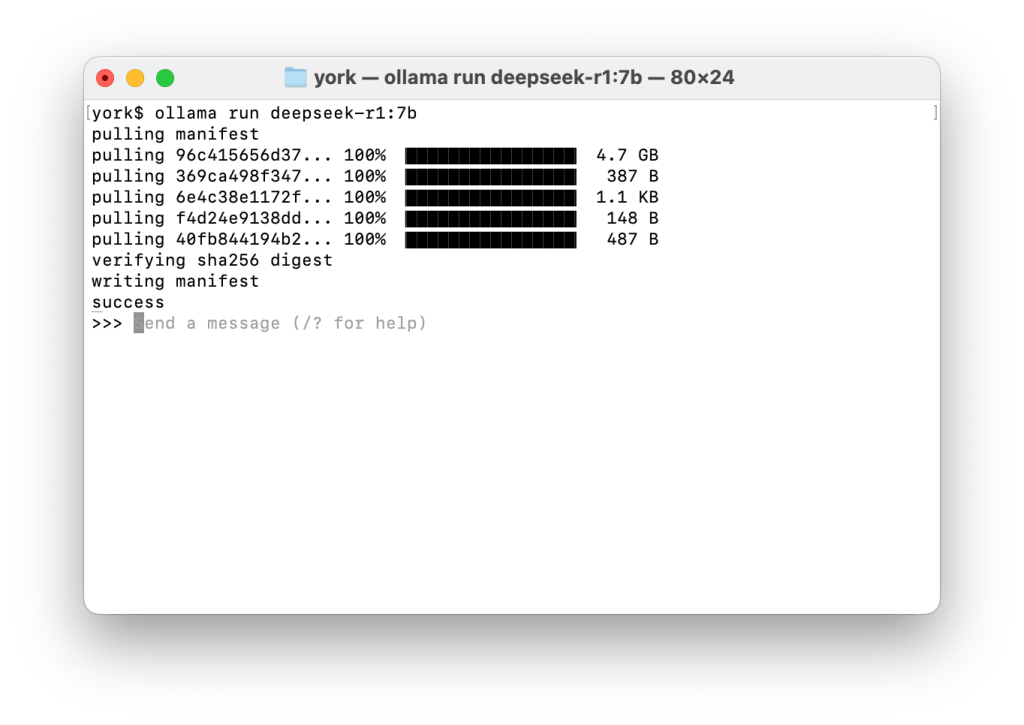
You now have a version of DeepSeek running on your computer. Have fun!
Note that in my example above I’m actually running a “distilled” smaller version of the full DeepSeek model. To run the full model with 671 billion parameters, you would type:
ollama run deepseek-r1:671bThat, however, requires 404 GB of disk space which is far more than my older Mac laptop had available! 🤯
So I went for the 7 billion parameter version that only required 4.7 GB of disk space. If you scroll down the Quick Start page of the documentation to where it says “Model library” you will see a list such as this (current as of March 1, 2025):
Model Parameters Size Download DeepSeek-R1 7B 4.7GB ollama run deepseek-r1DeepSeek-R1 671B 404GB ollama run deepseek-r1:671bLlama 3.3 70B 43GB ollama run llama3.3Llama 3.2 3B 2.0GB ollama run llama3.2Llama 3.2 1B 1.3GB ollama run llama3.2:1b… and many more… Now, it may not run as fast on your local computer as it does on the website, but that’s because the sites are powered by ginormous power-sucking data centers with huge numbers of specialized chips! (GPUs) But depending upon your computer, it may be “good enough”.
Why Is This Interesting?
One of my concerns about the latest artificial intelligence (AI) hype cycle with large language models (LLMs) is that in using them on a web site, you are giving the LLM operator all your information that can be used in further training their LLM. And, potentially… could then show up in answers to other people’s prompts.
I don’t want the LLM operator to have any data from me, even if it is just a profile of the kind of things I want to ask about.
And… sometimes I’d like to use a LLM on more private data or information. For instance, while developing a document I intend to later publish. Many companies may not want “internal” or confidential data to be shared with a LLM… that might then use that data for training so that it could show up in someone else’s answers.
The great part about running a LLM locally is that your data STAYS local.
And yes, I’m also just a paranoid “security/privacy guy”! 🤣
The other cool part about this is that for your own personal “resilience”, you can have a LLM available locally if your Internet connection goes down, or if there is a power outage (as long as you can power your computer), or anything else. Having applications locally available is an excellent preparation in uncertain times.
Beyond the Prompt – Using Graphical Clients
But what if you want to do more than just enter in text prompts? The cool part about Ollama being open source is that the community has built MANY clients that work with Ollama! Just look down the long list. There are graphical clients for desktops.. there are web interfaces… terminal clients… cloud integrations… mobile apps… libraries…….. SO MANY THINGS!
I downloaded Ollamac for my Mac and it’s been a great interface for the kind of basic querying that I’m doing.
Next up I’m going to be exploring several that will allow you up upload documents and then have the LLM use those documents as reference. (You could imagine “Write a blog post based on these two reports in the style of these posts” 😀). In the language of LLMs, this is called Retrieval-Augmented Generation (RAG) and so I’ll be exploring the clients that support RAG.
This is all possible because Ollama starts up a server on port 11434 on your local computer to which all of these clients can connect.
There is SO MUCH documentation available that you can easily go down a DEEP rabbit hole once you start! There is the main Github repository and which includes the specific documentation section. There is the Ollama blog. And there are many articles out there. (I’m sure there are also YouTube and TikTok videos, too.)
I hope you all have as much fun with it as I’m having! (And please do send back your comments or suggestions about what you have found most fun or interesting.)
And a tip of the hat to Jim Cowie who wrote about this in one of his posts. I knew it was “easy” to run LLMs locally, but I honestly didn’t know HOW easy until I read Jim’s post!
An “Crow’s Nest” Monthly Video Call?
I’ve been giving a LOT of thought about building communities and connecting with others of similar interests. I’m thinking about the idea of doing a monthly video call (probably using Zoom) for a casual conversation where people could share what kind of emerging technologies they are currently interested in. *IF* I were to set something like that up, would you be interested? Drop an email back to me to let me know (or ping me on Mastodon or LinkedIn).
[The End]
Recent Posts and Podcasts
Content I’ve published and produced recently on my personal sites:
- (none)
Content I’ve published for the Internet Society (who has no connection to this newsletter):
- (none)
(It’s been a rough start to the year for those of us following politics… and I’ve struggled to get back into writing!)
Thanks for reading to the end. I welcome any comments and feedback you may have.
Please drop me a note in email – if you are a subscriber, you should just be able to reply back. And if you aren’t a subscriber, just hit this button 👇 and you’ll get future messages.
This IS also a WordPress hosted blog, so you can visit the main site and add a comment to this post, like we used to do back in glory days of blogging.
Or if you don’t want to do email, send me a message on one of the various social media services where I’ve posted this. (My preference continues to be Mastodon, but I do go on others from time to time.)
Until the next time,
Dan
Connect
The best place to connect with me these days is:
- Mastodon: danyork@mastodon.social
You can also find all the content I’m creating at:
If you use Mastodon or another Fediverse system, you should be able to follow this newsletter by searching for “@crowsnest.danyork.com“
You can of course send me email at dyork@Lodestar2.com
You can also connect with me at these services, although I do not interact there quite as much (listed in decreasing order of usage):
- LinkedIn: https://www.linkedin.com/in/danyork/
- Soundcloud (podcast): https://soundcloud.com/danyork
- Twitch: https://www.twitch.tv/danyork324
- TikTok: https://www.tiktok.com/@danyork324
- BlueSky: @danyork.bsky.social
I’m also on Instagram and Threads, but don’t tend to do much there anymore.
Disclaimer
Disclaimer: This newsletter is a personal project I’ve been doing since 2007, several years before I joined the Internet Society in 2011. While I may at times mention information or activities from the Internet Society, all viewpoints are my personal opinion and do not represent any formal positions or views of the Internet Society. This is just me, saying some of the things on my mind.
-
AVFTCN 038 – 5 Emerging Trends I’m Paying Attention to in 2025
As 2025 begins, I thought I’d climb up into the crow’s nest and share what I am paying attention to as this new year starts. Some of these are technologies, while others are policy areas or overall trends that have been emerging over the past few years.
Resilience
As I wrote about in my last newsletter, and also in my first post of 2025, and has been a theme in my recent writing and speaking for the Internet Society, I think we’re in a time when “resilience” is key. In the work I do, particularly with the Internet Society’s Pulse website, I’m focused on Internet resilience but as I wrote recently, I’m increasingly looking at the link between electrical / power resilience and Internet connectivity. For example, Puerto Rico had a massive power outage this past week that knocked out power for 90% of the island – and yet some amount of Internet connectivity continued. How do we do more of this and keep the Internet ON even without power from the grid?
All of this is part of the overall concern around climate resilience as we see more extreme weather and other challenges. I’m planning to spend several future newsletters exploring more around resilience.
Climate Tech
Related to resilience, there’s some fascinating work going on around technology to help either mitigate our impact on the climate or adapt to the ongoing changes. Last year I spent 12 weeks as a Fellow at Climatebase and it was an excellent experience to learn about the current state of climate tech. There are no silver bullets, of course, that will magically decrease our impact, but there are so many solutions for different problems that people are working on. It’s an exciting – and hopeful – area of activity!
Low Earth Orbit (LEO) Satellites
Anyone who has followed me on social media knows that “LEOs” are an area of intense interest for me! Back in 2022 I led a team at the Internet Society that developed a “perspectives” document about using LEO-based satellites for Internet access. Systems such as Starlink from SpaceX, and OneWeb from Eutelsat offer amazing opportunities to extend Internet access to the remotest corners of the world. The high speed, low latency connectivity can be very literally life-changing, but there are some definite tradeoffs and challenges we as a society have to accept.
So much has happened in the last 2 years! And I expect 2025 to be a VERY busy year with LEOs, particularly as Elon Musk’s proximity to incoming President Trump may accelerate some of SpaceX’s activities. The incoming FCC Chair has also said he wants to see fewer barriers to LEO system deployment. And… there are SO MANY companies and startups vying to be active in LEO-based connectivity, in countries all over the world. In 2025 we should see Amazon’s Project Kuiper get into orbit. There are a couple of Chinese constellations launching. Several more are in the works to launch.
The skies are going to be crowded! (Much to the disappointment of astronomers everywhere…)
Age-gating the Internet
A worrisome trend is that policymakers around the world seem to have decided that THIS is the time when they should pass laws to “protect children” and restrict access to parts of the Internet to only adults. To be clear, for as long as I’ve been online (40+ years now) there have always been concerns about how to restrict access by minors to some content. And as a father of two daughters, I completely understand the concerns.
BUT… there still isn’t a way to easily do this. Back in September 2024, the Internet Society joined several other organizations in filing an amicus brief explaining that existing technology just doesn’t work and creates serious security and privacy concerns for adults.
But this hasn’t stopped policymakers. Australia declared that in December 2025 all social media apps should not be available to anyone under 16. Never mind that the tech hasn’t been proven, they want to push compliance onto the platforms. A good number of US states have passed various laws. On January 15, 2025, the US Supreme Court will hear a case from Texas where the Texas Attorney General asserts that companies can “easily” do this.
This is going to continue to be a mess. And our privacy and security as individuals may wind up being “collateral damage” to many of these different well-intentioned laws.
WSIS+20 Review
This is a really wonky Internet policy area… but 2025 is the 20th anniversary of the World Summit on the Information Society (WSIS), the UN event that set the stage for how “Internet governance” is addressed at the UN level and also created the Internet Governance Forum (IGF) annual event. A key point is that it was declared to be “multistakeholder” and involve not just governments but people from all across society. In recent years, there have been some governments and others who would like to stuff the proverbial genie back in a bottle and change back to a “multilateral” process where only governments are involved with setting decisions about online governance.
This year will be the “WSIS+20” review and will set the stage for how governments engage within the UN framework around Internet policy issues – and whether we all have a voice. Colleagues of mine at the Internet Society wrote about why this is so important. We’ll see where this all goes in 2025.
AI, quantum, virtual worlds, neurotechnology, and everything else
Of course I’m also continuing to watch what’s going on in the world of generative AI – how can you NOT given the current level of hype? There are some definite cool aspects of the “data center-scale auto-complete” that we have today, but definite challenges, too. (Ex. The environmental and energy impact of massive data centers being built for AI apps.) It will be interesting to see what new capabilities 2025 brings.
Other topics:
- Quantum technologies also seem to be getting ever-closer to being something that could be used outside of research environments.
- Virtual worlds / metaverse / spatial computing continue to advance (ex Roblox now has 80 million daily active users).
- Some of these new augmented reality (AR) glasses seem to be gaining ground.
- Digital identity systems are something to watch (particularly related to age-gating).
- Advances in neurotechnology are helping many people, but there are also some scary, Orwellian aspects to some of the tech.
- 3D printing and other material development is an area I think may disrupt our society in more ways than is immediately apparent.
- Radio spectrum will be a major battleground for communication technologies.
- There are fascinating advances happening in medical technology.. for example, can we get to cancer treatments that are more like scalpels than sledgehammers?
- and…
- and…
… there are just SO many fascinating new technologies emerging!
What are YOU watching in 2025? Please do drop me an email or reply on social media to share where your attention is focused.
[The End]
Recent Posts and Podcasts
Content I’ve published and produced recently on my personal sites:
Content I’ve published for the Internet Society (who has no connection to this newsletter):
Thanks for reading to the end. I welcome any comments and feedback you may have.
Please drop me a note in email – if you are a subscriber, you should just be able to reply back. And if you aren’t a subscriber, just hit this button 👇 and you’ll get future messages.
This IS also a WordPress hosted blog, so you can visit the main site and add a comment to this post, like we used to do back in glory days of blogging.
Or if you don’t want to do email, send me a message on one of the various social media services where I’ve posted this. (My preference continues to be Mastodon, but I do go on others from time to time.)
Until the next time,
Dan
Connect
The best place to connect with me these days is:
- Mastodon: danyork@mastodon.social
You can also find all the content I’m creating at:
If you use Mastodon or another Fediverse system, you should be able to follow this newsletter by searching for “@crowsnest.danyork.com“
You can of course send me email at dyork@Lodestar2.com
You can also connect with me at these services, although I do not interact there quite as much (listed in decreasing order of usage):
- LinkedIn: https://www.linkedin.com/in/danyork/
- Soundcloud (podcast): https://soundcloud.com/danyork
- Twitch: https://www.twitch.tv/danyork324
- TikTok: https://www.tiktok.com/@danyork324
- BlueSky: @danyork.bsky.social
I’m also on Instagram and Threads, but don’t tend to do much there anymore.
Disclaimer
Disclaimer: This newsletter is a personal project I’ve been doing since 2007, several years before I joined the Internet Society in 2011. While I may at times mention information or activities from the Internet Society, all viewpoints are my personal opinion and do not represent any formal positions or views of the Internet Society. This is just me, saying some of the things on my mind.
-
AVFTCN 037 – Resilience, Connecting Carolina, and ITDRC Response
Climbing back up into the crow’s nest and turning the spyglass toward the southeastern United States, it’s hard to escape the utter devastation caused by the cascading effects of Hurricane Helene and Hurricane Milton. The photos are unbelievable. The stories are heartbreaking. The recovery costs will be enormous. And the people responding are amazing! (And the disinformation is despicable!🤬)
All of that has brought me back to this theme of “resilience” that has been percolating through my work for the past year or so. I have stories exploding inside my head that I want to write here.. so my plan is to start with my next issue on the theme of “Building Resilience” – both the network kind and the human kind, and both at a community and personal level. I just want to capture some of my own thoughts and thinking… and will invite you to come along with that exploration.
Meanwhile, I want to talk about two efforts happening RIGHT NOW to respond to the hurricanes in the southeast US…
The western part of North Carolina was devastated by Hurricane Helene. Many people might not have heard of Asheville, NC, before… but now they do. The whole are needs severe help! And soon!
Aaron Huslage, who I’ve known for many years, lives in North Carolina and in response launched Operation Connect Carolina to help restore connectivity. He’s got a team of people working hard to build mobile hotspots that can be moved out into western NC and deployed. You can follow the journey on the project’s Facebook page or LinkedIn page.
Most importantly, he’s seeking donations to help his local teams get these hotspots out to where people need them.
The second effort is the volunteers of the IT Disaster Resource Center (ITDRC). The organization has deployed throughout the region providing WiFi access and charging stations. If you are in the region, or know people who are, please share their map of WiFi locations in North Carolina, South Carolina, Georgia, and Florida.
Additionally, if you have some IT experience / background and are located in the USA, you can sign up to volunteer with the ITDRC. Volunteers are needed to deploy out into the field to help get these trailers set up and then to keep them up and running, and to generally help people with connectivity in the local community. It’s going to be a long haul to get connectivity restored all across the affected region, and to ITDRC is planning to be there for a while. They’ll need more volunteers to help keep all these systems going. There are also opportunities to provide remote support if you don’t have the ability to go out into the field for a couple of weeks (typically a 2-week deployment).
I’ve been an ITDRC volunteer since 2021 and while I have not yet deployed into the field (I need to finish up one last FEMA training course) I have learned a huge amount from the ITDRC training programs and community.
You can also donate to ITDRC as it is entirely a nonprofit operation. They’ve received multiple grants (including from the Internet Society Foundation, affiliated with my employer) which helps, but they do need all the support possible.
At the same time they are also supporting wildfire response out in the western United States. There are many communities in crisis that need connectivity!
If you are able to help with either effort… THANK YOU!
Next time, I intend to write a bit more about building resilience…
P.S. As you may notice, ITDRC only operates in the US. If you live elsewhere in the world and are active with a similar IT-related crisis response organization, please drop me an email with the info, as I’d love to share info. The NetHope organization includes members in other regions who do similar work.
[The End]
Recent Posts and Podcasts
Content I’ve published and produced recently on my personal sites:
Content I’ve published for the Internet Society (who has no connection to this newsletter):
- <nothing>
Thanks for reading to the end. I welcome any comments and feedback you may have.
Please drop me a note in email – if you are a subscriber, you should just be able to reply back. And if you aren’t a subscriber, just hit this button 👇 and you’ll get future messages.
This IS also a WordPress hosted blog, so you can visit the main site and add a comment to this post, like we used to do back in glory days of blogging.
Or if you don’t want to do email, send me a message on one of the various social media services where I’ve posted this. (My preference continues to be Mastodon, but I do go on others from time to time.)
Until the next time,
Dan
Connect
The best place to connect with me these days is:
- Mastodon: danyork@mastodon.social
You can also find all the content I’m creating at:
If you use Mastodon or another Fediverse system, you should be able to follow this newsletter by searching for “@crowsnest.danyork.com“
You can of course send me email at dyork@Lodestar2.com
You can also connect with me at these services, although I do not interact there quite as much (listed in decreasing order of usage):
- LinkedIn: https://www.linkedin.com/in/danyork/
- Soundcloud (podcast): https://soundcloud.com/danyork
- Twitch: https://www.twitch.tv/danyork324
- TikTok: https://www.tiktok.com/@danyork324
- BlueSky: @danyork.bsky.social
I’m also on Instagram and Threads, but don’t tend to do much there anymore.
Disclaimer
Disclaimer: This newsletter is a personal project I’ve been doing since 2007, several years before I joined the Internet Society in 2011. While I may at times mention information or activities from the Internet Society, all viewpoints are my personal opinion and do not represent any formal positions or views of the Internet Society. This is just me, saying some of the things on my mind.
-
AVFTCN 036 – A Hard Drive Failure, a Puppy, Climatebase, a New Role… and an Unplanned Hiatus
Hi! Remember this newsletter you subscribed to? The one you haven’t seen since back on April 22, 2024?
Welllllll… it’s been a wild ride… and an unplanned hiatus.
But… my goal now is to get back into this a bit more, and so I want to fire off this short note to just give a personal update.
Next time, I’ll be climbing up into that proverbial crow’s nest and looking out at the horizon ahead of us. For this newsletter… I’m going to look back instead at where the ship has sailed over the past few months.
If you visit my danyork.me aggregation site, you’d see that I have published some work articles… but nothing personal since the last issue (035) of this newsletter back on April 22, 2024. No blog posts. No podcast episodes. No newsletters. No livestreaming to Twitch. No… nothing. Zip. Nada. Zilch. Nichts.
So here’s the story…
The fun began back in early May when the 2017 iMac I’d been using to produce my podcasts, do all my livestreaming, and write many of my posts started acting really funky. It was acting very slow.. and freezing completely. Many reboots and upgrade attempts later, I was finally able to identify that it was having “S.M.A.R.T. disk errors”. Which wasn’t good.
“It’s dead, Jim” would be the Star Trek (Original Series) way to say it.
Given that it’s from 2017, I can’t upgrade it to the latest MacOS X. And heck, it’s so old Apple won’t even give me anything for a trade-in. (But they’ll help recycle it for me if I want. 🤦♂️) Giving other things going on (see below!) fixing it has been super LOW priority… which has meant that my normal platform for content creation and production has been offline. So no podcast episodes or livestreaming.
As that was all happening, a more massive disruption was entering our life – we adopted an 8-week-old puppy!
Named “Barkley”, he’s a very lovable and adorable mix of a pug and a miniature schnauzer (apparently called a “Schnug”) who keeps growing and growing and now at 6 months old is larger than our 17-year-old miniature poodle.
But.. my wife and I had never had a puppy before! We’ve had a couple of dogs (and cats) but they’ve all been a few years old when we adopted them. Anyone who has had a puppy probably understands what these last months have been like! Constantly watching where he is… “puppy-proofing” the entire house… constantly watching where he is… stopping him from eating everything… trying to train him a bit… constantly watching where he is… trying to prevent him from always attacking our 17yo dog… stopping him from eating whatever… oh, and constantly watching what he’s doing. It’s been… exhausting!
Basically like having a newborn child again… only one that can run fast all over and has sharp teeth! 😀
But in the end… he’s a wonderful addition and we’ve come to love him dearly. He’s curled up against my foot as I write this… and tomorrow night you’ll find me in a class with him.
While all of this was going on, I was also enrolled as a Climatebase Fellow in a very intense 12-week program of 10-15 hours of sessions each week all related to improving my understanding of the current state of information and science around climate change. As shown in the image below, it covered a very wide range of topics:

Participating in this fellowship was part of my professional development at my employer, the Internet Society. In the last issue, I pointed to my article about “The Internet and Climate Change” and that continues to be an area of great interest and exploration for me. I’ll undoubtedly write some future newsletters specifically around this whole area.
My interest was mostly to refresh my understanding of current climate thinking. I’ve been involved in “environmental” issues since the 1980s, and was very active in the broader movement in the early 1990s, serving in different volunteer leadership roles for different organizations. But then life took me away from that heavy involvement and my knowledge has aged. I heard phrases like “regenerative agriculture” but didn’t know what they meant. (Now I do!)
It was a good program and I met some great people and enjoyed participating in the community (which I am still doing).
As we came into summer here in Vermont, the Climatebase Fellowship wrapped up, but the intensity of the puppy and work and family and everything else continued.
And then a very cool opportunity was presented to me… at the Internet Society we had a new President and CEO, Sally Wentworth, start on September 1, 2024. Back in July she approached me about taking on a new role that we eventually called “CEO communications” where I’m helping with developing and executing plans across both the Internet Society and Internet Society Foundation for consistent communication from the CEO’s office internally, externally, and with our community and partners.
I formally took on this role on September 1 (and mentioned something on LinkedIn later) but began some aspects of it back in August. I’ve known Sally for the 13 years that I’ve been at the Internet Society (she’s been there 15 years) and have deep and great respect for her. So I’ve been excited about the new role, grateful for this opportunity to stretch my own skills in new and different ways… and just… busy! 😀
And now on this 24th day of September… it’s time to get back in the flow again and start creating some content again. There are so many stories to tell… so many changes happening… so much ahead on the horizon… both icebergs to avoid and opportunities to explore!
Time to climb up into that crow’s nest, whip out the spyglass, and get back to looking out ahead at the horizon and sharing what I see!
See you soon!
[The End]
Recent Posts and Podcasts
Here is some of the content I’ve published and produced recently on my personal sites:
- <nothing!>
[I do still contribute reports to the “monthly” episodes of the For Immediate Release podcast.]
I did publish some new posts for the Internet Society (who has no connection to this newsletter):
- Montana’s TikTok Ban: Breaking the Internet and Undermining Online Privacy
- Kenya Internet Disrupted Amidst Protests
- US Supreme Court Upholds Right of Websites to Moderate Content
- Global Tech Outage Demonstrates Need for Resiliency in Software Systems
- Texas’ Mandatory Age Verification Law Will Weaken Privacy and Security on the Internet
More on why so many of them are law-related… in a future newsletter!
Thanks for reading to the end. I welcome any comments and feedback you may have.
Please drop me a note in email – if you are a subscriber, you should just be able to reply back. And if you aren’t a subscriber, just hit this button 👇 and you’ll get future messages.
This IS also a WordPress hosted blog, so you can visit the main site and add a comment to this post, like we used to do back in glory days of blogging.
Or if you don’t want to do email, send me a message on one of the various social media services where I’ve posted this. (My preference continues to be Mastodon, but I do go on others from time to time.)
Until the next time,
Dan
Connect
The best place to connect with me these days is:
- Mastodon: danyork@mastodon.social
You can also find all the content I’m creating at:
If you use Mastodon or another Fediverse system, you should be able to follow this newsletter by searching for “@crowsnest.danyork.com“
You can of course send me email at dyork@Lodestar2.com
You can also connect with me at these services, although I do not interact there quite as much (listed in decreasing order of usage):
- LinkedIn: https://www.linkedin.com/in/danyork/
- Soundcloud (podcast): https://soundcloud.com/danyork
- Twitch: https://www.twitch.tv/danyork324
- TikTok: https://www.tiktok.com/@danyork324
- BlueSky: @danyork.bsky.social
I’m also on Instagram and Threads, but don’t tend to do much there anymore.
Disclaimer
Disclaimer: This newsletter is a personal project I’ve been doing since 2007, several years before I joined the Internet Society in 2011. While I may at times mention information or activities from the Internet Society, all viewpoints are my personal opinion and do not represent any formal positions or views of the Internet Society. This is just me, saying some of the things on my mind.
-
AVFTCN 035 – 3 Articles To Read On Earth Day
Today is Earth Day… and when I climb up into that crow’s nest, hold up my spyglass, and look out at the horizon… it can look pretty bleak. It seems like the whole world is on fire in different ways. But amidst the chaos… what gives me hope is seeing people taking action. And they are!
Today I offer you three articles to hopefully provoke some thoughts on this day: one by me and two by others.
”The Internet and Climate Change” – In this article that I published today on the Internet Society’s site, I explored how the Internet is helping address climate change, how the Internet is harming the climate, and how the Internet’s infrastructure is at risk in the face of our changing climate.
I’ve been talking about these topics with many different people, but this article was my first attempt to bring all these thoughts together into one piece. I would love any feedback you have! Was it helpful? Did you learn something? Do you have ideas or pointers to other people working on these topics? Or do you think I have things all wrong? Or are there other articles or papers you think I should read?
Please do let me know any feedback. If you received this via email, you should just be able to reply. If not , you can send it to me at dyork@lodestar2.com .
If you are looking for a speaker or a panelist for a workshop, podcast, webinar, video, presentation, etc. about this whole topic… it’s one I’m looking to spend more time on and I’m eager to engage in discussions about!
“The Staggering Ecological Impacts of Computation and the Cloud” – in this excerpt from a longer case study for MIT Press, anthropologist Steven Gonzalez Monserrate dives DEEP into the data centers that power all the applications and services we use every day. He goes first into energy consumption, offering staggering statistics along the way, including:
The Cloud now has a greater carbon footprint than the airline industry. A single data center can consume the equivalent electricity of 50,000 homes.
He goes on to talk about the enormous amounts of water required by data centers, and then gets into the noise pollution that affects local communities. His excerpt concludes with a section about the huge amount of electronic waste generated from data centers, and some final thoughts.
If you’ve been looking to understand climate impacts of the apps and services we use, this is a great piece!
”We Need To Rewild The Internet” – This is an amazing article by Maria Farrell and Robin Berjon! It’s not about climate change … or anything directly related to Earth Day… but rather it uses the lens of ecology to look at today’s Internet, and to offer suggestions for its future. As they subtitle it:
The internet has become an extractive and fragile monoculture. But we can revitalize it using lessons learned by ecologists.
It’s a brilliant piece! I enjoyed it and found it so powerful that I just may have to write an entire newsletter about it. I probably will… but in the meantime I wanted to get this out to you all.
BONUS: One fourth article to wrap on a hopeful note – if you have not read “Collapse, Renewal and the Rope of History” from the folks at FutureCrunch, do so now! It’s another amazing piece of writing that gets to the core of the stories we tell … to ourselves… and to everyone else.
With that, I wish you a Happy Earth Day! And… the reminder that really every day must be Earth Day if we are to keep living on this pale blue dot of ours! 🌏
[The End]
Recent Posts and Podcasts
Here is some of the content I’ve published and produced recently on my personal sites:
- Celebrating 20 Years as a Wikipedia Editor – and the companion podcast episode TDYR 416 – 20 Years of Wikipedia Editing
- 1,000 Days of Journaling with Day One
- The Github Malware Attack – and the Importance of Trusting the Repository You Use
- New Excellent Analysis of Where IPv6 Grew in 2023
And new posts I wrote for the Internet Society (who has no connection to this newsletter):
- Nevada Wants to Reduce Online Protections for Children: All Internet Users Should Benefit from Strong Encryption
- Protection for Intermediaries Is Vital for the Internet in Mexico
- Major Internet Outages Across Western and Southern Africa Today
- Internet connectivity disrupted in Chad amidst unrest
- 3 Years On, Myanmar’s Internet Service Blocking Results in $232 Million Loss
Thanks for reading to the end. I welcome any comments and feedback you may have.
Please drop me a note in email – if you are a subscriber, you should just be able to reply back. And if you aren’t a subscriber, just hit this button 👇 and you’ll get future messages.
This IS also a WordPress hosted blog, so you can visit the main site and add a comment to this post, like we used to do back in glory days of blogging.
Or if you don’t want to do email, send me a message on one of the various social media services where I’ve posted this. (My preference continues to be Mastodon, but I do go on others from time to time.)
Until the next time,
Dan
Connect
The best place to connect with me these days is:
- Mastodon: danyork@mastodon.social
You can also find all the content I’m creating at:
If you use Mastodon or another Fediverse system, you should be able to follow this newsletter by searching for “@crowsnest.danyork.com“
You can of course send me email at dyork@Lodestar2.com
You can also connect with me at these services, although I do not interact there quite as much (listed in decreasing order of usage):
- LinkedIn: https://www.linkedin.com/in/danyork/
- Soundcloud (podcast): https://soundcloud.com/danyork
- Twitch: https://www.twitch.tv/danyork324
- TikTok: https://www.tiktok.com/@danyork324
- BlueSky: @danyork.bsky.social
I’m also on Instagram and Threads, but don’t tend to do much there anymore.
Disclaimer
Disclaimer: This newsletter is a personal project I’ve been doing since 2007, several years before I joined the Internet Society in 2011. While I may at times mention information or activities from the Internet Society, all viewpoints are my personal opinion and do not represent any formal positions or views of the Internet Society. This is just me, saying some of the things on my mind.
-
AVFTCN 034 – The Cautionary Tale of the Death of Ello
Do you remember… Ello? For a brief time in 2014 to 2016-ish, it flared up as “the next emerging social network” and even as a “Facebook-killer”. And then it flamed out… and… in the summer of 2023, it disappeared completely as the site was taken offline.
I was all in with Ello for a time! Kind of as Mastodon is today for me, Ello was where I was focused on posting and engaging. And then it wasn’t…
Andy Baio published last month a long, detailed post on “The Quiet Death of Ello’s Big Dreams”. I encourage you to go read it… and then I’ve got some commentary below.
As I climb up in that crow’s nest and look out at the horizon, his post points out some definite icebergs and opportunities for any of the new social networks…
… and also, again, the point that we need to own our own content!
Go ahead! Go read that… and then come on back here. 🙂
The Promise of Ello
As Andy Baio writes, the promise of Ello was that it was going to be different. You can still read the Ello Manifesto via the Wayback Machine:
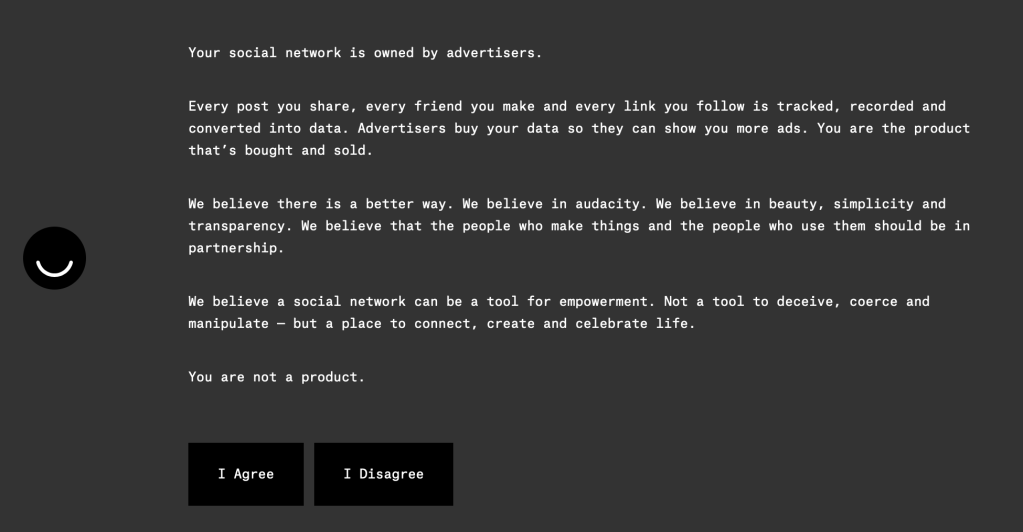
It was beautiful!
Here’s the part I liked:
“We believe there is a better way. We believe in audacity. We believe in beauty, simplicity and transparency. We believe that the people who make things and the people who use them should be in partnership.
We believe a social network can be a tool for empowerment. Not a tool to deceive, coerce and manipulate — but a place to connect, create and celebrate life.
You are not a product.”
How could you NOT sign up for that?? Particularly in a time (2014) when Facebook was going through yet another series of changes and pivots.
I jumped deep in. Partly because of that manifesto. Partly because I liked the minimalist ethos and design. And partly, if I’m honest, because one of the co-founders was from Vermont, and while I was living next door in New Hampshire, the site had a bit of the “Vermont vibe”. It was designed to be artsy and counter-cultural, etc. I was good with that!
I wrote a bunch of posts. I talked about Ello on other social networks. I added it to the footer on my blog sites to encourage people to follow me there.
I encouraged people to join Ello – and was very excited about the ability to use Markdown in posts. I wrote about some of the exciting things that were going on and some of the posts from other early adopters.
The Wayback Machine shows that at the end of my time there, I had published 374 posts, was following 177 people, and was followed by 457 people.
The Dream Was Built On A Problem
The thing was, the whole beautiful dream was built on foundation of quicksand. As Andy Baio writes, they started out with $435,000 of venture capital (VC) funding, and soon got $5.5 million more… and six months later took $5 million more in VC funding and later some more.
Baio’s article covers this all in more detail, but the key point is:
- VC’s always want their exit!
They’re not doing this out of the kindness of their hearts. They are investors who ultimately want to make a profit from their investment.
The moment you take VC investment, your future direction is guided by your investors – and their need for payback – sometimes even more so than your actual users.
Which is fine if you are a regular startup. Everyone understands now that “this is how it works” – and VC firms have played a very vital role in helping so many of the services we use to come into being.
BUT… when you are a social network that specifically positions itself as NOT “selling out” to the market… well… that’s a problem.
And Then It Was… Gone…
As Baio recounts in his piece, Ello then morphed through more “pivots”, was acquired by Talenthouse, and more changes happened.
Somewhere in there I left it behind. I found their pivot to “The Creators Network – Built by artists for artists” an interesting change… but they focused on visual arts with photography, images, artwork… and I’m a guy who likes text and audio. 🤷♂️ So it was kind of clear that it was no longer really a great place for me.
Besides which, by then I’d discovered Mastodon in its early days (Dec 2016) and was starting to spend more time there. (Oh, look at the butterfly… so beautiful! SQUIRREL!!!)
And then, last year in July 2023, after a series of outages, the Ello site simply vanished. Boom. Done.
No warning. No messages to users. No opportunity to download your content. No information. Nothing. Zip. Nada.
In his piece, Baio captures some of the surprised and angry responses of users. People who had watched 8 years of work just vanish from the Internet (thankfully, the Internet Archive captured a good bit of it).
What We Can Learn
In the end, the cautionary tale of Ello reminds us yet again that:
- We must own our own content!
We can’t assume that anything we put into ANY of the platforms will continue to exist indefinitely. If we want that content to be available, we need to put it somewhere that WE control.
This means … yes… thinking about good old personal websites again! Personal sites that we might actually have to pay a little bit for. And ideally with our own domain.
Now, the good news is that you can start very easily these days. For example this newsletter is on the hosted WordPress.com site. I don’t have to do much admin and I’m not paying much. The advantage is that I can export this entire site and save it on a disk drive. And I can easily import that to a new hosting provider if I want. And I guess I trust Automattic enough that I believe they wouldn’t just shut down and disappear – particularly not with how many millions of websites are hosted on WP.com.
There are other non-WordPress solutions that are similar, too. And there are a zillion newer frameworks for starting up your own site if you are okay playing with some code. The point is that you can set yourself up fairly easily with a website.
You can own your own content.
POSSE and PESOS
But then of course comes the problem of USING your own website(s). It is SO MUCH EASIER to just open an app or social network site and post your thoughts and reflections.
Open app. Type or upload photo. Publish. Boom. Done.
Which is why we have so much of our content locked up inside walled gardens owned by others. It’s why so many people contributed on Ello and all the other past social networks (and all the ones today).
But we need to change our habits if we don’t want to be victims to the next Ello that vanishes.
Back in 2018, I wrote about the “POSSE” idea that came out of the IndieWeb movement:
Publish on your
Own
Site,
Syndicate
ElsewhereBasically… start writing on your own site… and then share it out onto social networks.
And I try to do this… even on Mastodon, my current focus area. (Because at some point Mastodon GmbH could conceivably run out of money and shut down mastodon.social.) I mean… I will post short things to Mastodon that I really don’t care about. They are mostly ephemeral comments that I don’t really care whether they are around in the future.
But… the moment I start thinking about writing a thread of multiple posts on Mastodon, I ask myself the critical question:
- Can I post this on one of my own sites first?
And then I go write it on that site, and share the link on Mastodon. Or I may in fact create a Mastodon thread… but with the knowledge that it’s all captured back on my own site.
Alternatively, the other approach is to keep on publishing content on platforms as you do today, but then capture all your content back onto a site you control. This has been referred to as PESOS:
Publish
Elsewhere
Syndicate to
Own
SiteElizabeth Thai wrote a great post comparing POSSE and PESOS last year. She also wrote a follow-up post explaining her (mostly manual) way of bringing her content back onto her own site.
There are of course tools and plugins that can automate this. I do a form of this with my danyork.me site that pulls in copies of things that I write across the Internet. It’s using a WordPress plugin that just pulls regular old RSS feeds – and so naturally works only with things that have RSS feeds. There are other plugins that can bring in your posts from other services. If you want to go the PESOS route, it is now possible where you can mirror most of the various services onto a site under your control.
The Key Point
To something Elizabeth Thai wrote in her second post… I don’t know that I really want to capture everything that I share on social networks. A cool feature of Mastodon is that you can get a RSS feed of your posts. I could add that to my danyork.me aggregator site… but do I really care about some of those posts? Not really!
The key point in all of this is:
- If a site where you frequently publish content were to just disappear as Ello did, WOULD YOU BE OKAY WITH THAT?
- Or would you wish that you still had access to some of what you published there?
If the answer to the second question is yes, then it’s time to be thinking about how to bring that content onto a site that YOU control. Many sites have ways to get historical archives (but some don’t).
But even if you can’t easily get the historical posts, you can at least change your habits for new posts. Whether you choose POSSE or PESOS … or some other idea… the key point is to start owning your own content.
Because at some point all the various platforms and services may pull an Ello on us and just disappear. Or they may change their business model (um… Medium!) so that it’s harder for people to find your content.
As the enshittification of most platforms continues, the cautionary tale of Ello is that if we care about the content we publish, then we need to own where it is published.
[The End]
Recent Posts and Podcasts
Here is some of the content I’ve published and produced recently on my personal sites:
- The Joys Of Being Your Own IT Department – And Of DNS and RSS
- Podcast – TDYR 415 – Why ULA’s Vulcan Centaur Launch Was So Important
- TikTok video about using a leafblower with snow 🤣
And new posts for the Internet Society (who has no connection to this newsletter):
- Attack On Chad’s Internet Infrastructure Highlights Need for More Resilience
- Comoros Internet Suspended Among Election Unrest
- Nominations Open for 2024 Public Interest Registry (PIR) Board of Directors
Thanks for reading to the end. I welcome any comments and feedback you may have.
Please drop me a note in email – if you are a subscriber, you should just be able to reply back. And if you aren’t a subscriber, just hit this button 👇 and you’ll get future messages.
This IS also a WordPress hosted blog, so you can visit the main site and add a comment to this post, like we used to do back in glory days of blogging.
Or if you don’t want to do email, send me a message on one of the various social media services where I’ve posted this. (My preference continues to be Mastodon, but I do go on others from time to time.)
Until the next time,
Dan
Connect
The best place to connect with me these days is:
- Mastodon: danyork@mastodon.social
You can also find all the content I’m creating at:
If you use Mastodon or another Fediverse system, you should be able to follow this newsletter by searching for “@crowsnest.danyork.com“
You can of course send me email at dyork@Lodestar2.com
You can also connect with me at these services, although I do not interact there quite as much (listed in decreasing order of usage):
- LinkedIn: https://www.linkedin.com/in/danyork/
- Soundcloud (podcast): https://soundcloud.com/danyork
- Twitch: https://www.twitch.tv/danyork324
- TikTok: https://www.tiktok.com/@danyork324
- BlueSky: @danyork.bsky.social
I’m also on Instagram and Threads, but don’t tend to do much there anymore.
Disclaimer
Disclaimer: This newsletter is a personal project I’ve been doing since 2007, several years before I joined the Internet Society in 2011. While I may at times mention information or activities from the Internet Society, all viewpoints are my personal opinion and do not represent any formal positions or views of the Internet Society. This is just me, saying some of the things on my mind.
-
AVFTCN 033 – Kiwix, Meshtastic and content and connectivity during an outage
Tonight here in northwestern Vermont we’re supposed to get the double trouble of heavy, wet snow and a windstorm with winds up to 49 mph (79 kph). The combination will undoubtedly cause trees to fall, taking down power and Internet cables. Forecasters are expecting power outages all across the state.
In these moments, I often think about what we would do in an extended power or Internet outage. Specifically, I think about:
- How can we access Internet content offline? (Without a connection)
- How can we communicate without Internet or telecom connectivity?
In this newsletter, I’ve got a couple of thoughts….
Accessing Internet content… offline.
Given that we store so much of our information online – what do you do without a connection? Do you have local repositories / copies of all your critical files?
But also – what if you want to look up information? Say… from Wikipedia? How do you do that?
Readers who have been around for a while may be already saying “That’s simple, Dan, I just use
curl,wget, or something similar to pull down a copy of a website!”And yes, you can do that. It works.
But there’s a far more elegant solution – Kiwix!
Kiwix is software that lets you download Internet content so that you can read it offline. It started out focused on Wikipedia, but has expanded since then to cover other sites. The cool thing is that you can use Kiwix in several ways:
- On a desktop computer (Mac, Windows, Linux)
- On a mobile phone (IOS, Android)
- On a Raspberry Pi (which you could then use with WiFi to serve as a local hotspot)
(There are also browser extensions for popular browsers, which could work with a server product they offer, or simply with the “zim” files stored in a folder on a drive..)
You then download the appropriate packages of content (“zim” files) and… ta da… you are using the site offline!
If you have a free 109 GB, you can download the entire 6.3 million articles from English Wikipedia and have your own offline copy. They also have packages of all sorts of subsets of Wikipedia – the top 100 pages, various sections, with-and-without images, and more.
The Kiwix library currently has hundreds of “books” that you can download for offline access. (At this moment, it says “1010”, but that includes multiple different download options for many of the sites.) There is also content from TED Talks and more.
The nice part is you can just have Kiwix on your mobile phone with some site content – and then as along as you can keep your phone charged, you can have access to all the Internet content.
Kiwix is a nonprofit organization primarily supported by users and foundations (including the WikiMedia Foundation) and they are doing good work. I do encourage you to check them out!
There are of course other solutions out there for offline access of Internet content. Do you have one you like? If so, please drop me a note – I’m always curious about solutions people find.
Messaging without Internet connectivity
I often wonder – what would we do if we had an extended power outage for multiple days? It’s been a while, but we have had ice storms that knocked out power and Internet for several days … or even longer. We saw some of the extreme storms last year that knocked out connectivity for days or weeks in other parts of the world.
Like all good Vermonters, we have a portable generator that we could use to provide some electricity. We live in an area with many homes that would probably get attention from the utility companies and so might not be out for too long.
But what if we were? How could we communicate with other people in our area if we didn’t have Internet or telecommunications?
One option of course would be to get a Starlink antenna. They can work with minimal power and so we could use it to get Internet access and be able to communicate with others. If other people in the area also had Starlink dishes we could be able to connect.
I do think there is tremendous power in the low Earth orbit (LEO) satellite systems to add another layer of resilience.
BUT… that requires people to have the Starlink equipment, pay for subscriptions, etc.
What other ways are possible?
I don’t have a specific answer yet myself that I have worked with.
But I’m intrigued by what the folks involved with Meshtastic are doing. As they say, it is “an open source, off-grid, decentralized, mesh network built to run on affordable, low-power devices.”
It’s pretty cool! It’s based off of using “LoRa” hardware and unlicensed spectrum. The Meshtastic documentation does a decent job of explaining what it is all about and how it works.
WARNING! This all gets über-geeky and dives down into building your own hardware, installing your own software, etc. If you like that kind of thing, it’s awesome. If not… you may just want to skip ahead. 😀
I was going to write more details… but I found that someone else already did! By way of a Mastodon post, I found that a person going by the name of “Hydroponic Trash” has written “a guide on building autonomous, off-grid, encrypted, and solar-powered communications infrastructure that lets you send text messages without any cellular or power infrastructure.”
You can view it at:
(Yes, it’s on Substack… but you can still read it, and the person is working on make a PDF available on his website.)
Fair warning that as he gets toward the end, he gets into use cases and you may not agree with his politics. But if you focus on the first 3/4 of the article, it’s fascinating to see all the parts and pieces that can create this kind of low-power, off-grid communications network.
I’m personally hoping we don’t get to the point where we need systems like this… but given the increasingly extreme weather we’re seeing, who knows! I’m glad there are people out there working on solutions like these.
What other communication ways have you seen to add resiliency to our communications?
Thanks for reading to the end. I welcome any comments and feedback you may have.
Please drop me a note in email – if you are a subscriber, you should just be able to reply back. And if you aren’t a subscriber, just hit this button 👇 and you’ll get future messages.
This IS also a WordPress hosted blog, so you can visit the main site and add a comment to this post, like we used to do back in glory days of blogging.
Or if you don’t want to do email, send me a message on one of the various social media services where I’ve posted this. (My preference continues to be Mastodon, but I do go on others from time to time.)
Until the next time,
Dan
Connect
The best place to connect with me these days is:
- Mastodon: danyork@mastodon.social
You can also find all the content I’m creating at:
If you use Mastodon or another Fediverse system, you should be able to follow this newsletter by searching for “@crowsnest.danyork.com“
You can of course send me email at dyork@Lodestar2.com
You can also connect with me at these services, although I do not interact there quite as much (listed in decreasing order of usage):
- LinkedIn: https://www.linkedin.com/in/danyork/
- Soundcloud (podcast): https://soundcloud.com/danyork
- Twitch: https://www.twitch.tv/danyork324
- TikTok: https://www.tiktok.com/@danyork324
- BlueSky: @danyork.bsky.social
I’m also on Instagram and Threads, but don’t tend to do much there anymore.
Disclaimer
Disclaimer: This newsletter is a personal project I’ve been doing since 2007, several years before I joined the Internet Society in 2011. While I may at times mention information or activities from the Internet Society, all viewpoints are my personal opinion and do not represent any formal positions or views of the Internet Society. This is just me, saying some of the things on my mind.
-
Subscribe
Subscribed
Have a WordPress.com account? Log in now.

